Visualizing Workplace Dynamics: The Strategic Value of Employee Word Concept Banners
In the rapidly evolving landscape of corporate communication, the ability to distill complex human resource concepts into immediate visual understanding is a critical skill. Organizations today are not just managing tasks; they are managing narratives, cultures, and the psychological adaptation of their workforce. This is where specialized graphic assets, such as an Employee Word Concepts Banner Set, transition from mere decorative elements to essential strategic tools. These resources provide a foundational vocabulary for visual storytelling, allowing businesses to articulate themes like job adaptation, team synergy, and professional growth with clarity and impact.
The modern workplace is saturated with information. From onboarding manuals to internal newsletters and digital dashboards, employees are constantly bombarded with text-heavy communications that often fail to resonate. By leveraging vector illustrations and isolated typography, companies can break through this noise. A well-designed banner set does more than fill space; it anchors the viewer's attention and reinforces the message through semiotic association. When a concept like "Job Adaptation" is paired with a specific iconographic representation—perhaps a puzzle piece fitting into a larger mechanism or a bridge connecting two points—the abstract becomes tangible.
The Psychology of Visual Adaptation in Onboarding
One of the most challenging phases in an employee's lifecycle is job adaptation. This period involves not only learning new technical skills but also acclimating to a unique social ecosystem and corporate culture. Traditional text-based training materials often struggle to convey the emotional and psychological nuances of this transition. Here, the utility of an Employee word concepts banner set becomes evident. These assets allow HR professionals and instructional designers to create infographics that map out the journey of adaptation visually.
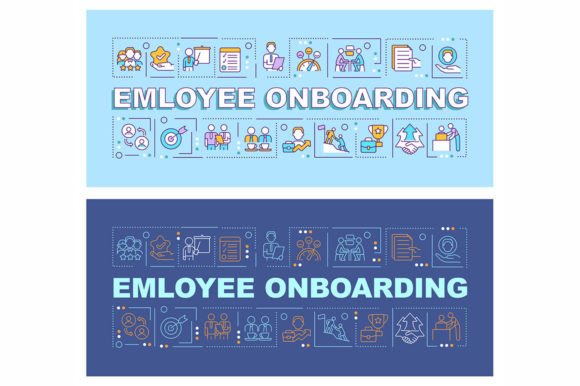
Consider the use of editable icons on a color background. Color psychology plays a significant role in how information is received. Warm tones might suggest collaboration and energy, while cooler tones can imply stability and focus. By utilizing a banner set that offers these variations, creators can tailor the visual tone to match the specific stage of the onboarding process. For instance, a banner highlighting "Initial Orientation" might use vibrant, inviting colors to reduce anxiety, whereas a banner for "Performance Review" might utilize more structured, neutral palettes to denote seriousness and objective analysis.
Furthermore, the inclusion of isolated typography allows for seamless integration into existing brand guidelines. Whether an organization uses Arial-Black for bold statements or a custom typeface for body copy, the flexibility to manipulate text elements ensures that the visual asset feels native to the company's identity rather than a generic stock addition. This level of customization fosters a sense of belonging and professionalism, subtly reinforcing the message that the company invests in high-quality communication.
Technical Versatility Across Digital and Print Media
The true power of a comprehensive graphic resource lies in its adaptability across various media formats. A robust Employee Word Concepts Banner Set typically includes files in EPS, SVG, PNG, JPEG, and AI formats. This diversity is not merely a technical specification; it represents the freedom to deploy these visuals anywhere they are needed without compromising quality.
For digital applications, such as mobile app screen pages or web-based learning modules, vector formats like SVG and AI are indispensable. They ensure that icons and banners remain crisp and clear regardless of the screen resolution or device size. In an era where remote work and mobile-first strategies dominate, the ability to scale graphics without pixelation is crucial for maintaining a professional appearance. Conversely, for print materials like brochures, office signage, or welcome packets, high-resolution PNG and JPEG files derived from the original vector sources provide the necessary density for sharp printing.
The availability of editable templates means that the workflow for content creation is significantly streamlined. Designers do not need to start from scratch for every new initiative. Instead, they can take a core concept template—such as one focused on "Team Collaboration"—and modify the specific text or swap out an icon to reflect a new project or departmental goal. This efficiency allows creative teams to focus on higher-level strategic thinking rather than getting bogged down in repetitive design tasks.
Enhancing Internal Communications and Engagement
Internal communication is often the backbone of organizational success, yet it is frequently the most neglected area of design investment. Employees are more likely to engage with content that is visually appealing and easy to digest. Infographic templates built around employee concepts serve as powerful vehicles for disseminating important updates, policy changes, or cultural initiatives.
For example, a quarterly newsletter discussing changes in benefits packages can be transformed from a dry list of bullet points into an engaging visual narrative. By using a banner header that clearly defines the section and supporting icons that represent health, finance, and time off, the information becomes accessible at a glance. This approach respects the employee's time and cognitive load, increasing the likelihood that the message will be read and understood.
Moreover, these visual tools are invaluable for non-designers within an organization. Marketing managers, team leads, and HR coordinators often need to produce presentations or reports but lack advanced graphic design skills. A pre-packaged set of concept banners with editable elements democratizes design, empowering these stakeholders to create polished, professional-looking materials independently. This autonomy speeds up communication cycles and ensures consistency in visual messaging across different departments.
Strategic Applications Beyond Human Resources
While the primary association of an Employee word concepts banner set is with Human Resources, its applications extend far beyond hiring and onboarding. In the realm of Learning and Development (L&D), these assets can be used to structure course curricula, highlight key learning outcomes, and visualize career progression paths. A series of banners can effectively illustrate the steps from "Novice" to "Expert," providing learners with a clear roadmap of their professional development.
In the context of change management, visual consistency is key to reducing uncertainty. When an organization undergoes a merger, restructuring, or a shift in strategic direction, consistent visual cues help anchor the workforce. Using a unified set of icons and typographic styles across all communication channels regarding the change helps to create a cohesive narrative. It signals that despite the turbulence, there is a structured plan and a clear vision guiding the transition.
Additionally, these resources are highly effective for external employer branding. Recruitment campaigns on social media, career page landing sites, and job fair booths all benefit from strong visual identity. A banner set that articulates core values like "Innovation," "Integrity," and "Community" helps potential candidates visualize what it is like to work at the company before they even apply. It transforms abstract corporate values into concrete visual promises.
The Importance of Editable and Scalable Assets
The constraint of static imagery is a common pitfall in corporate design. Once a image is flattened into a single JPEG, its utility is limited to that specific instance. The value proposition of a zip file containing concept banner templates in vector formats is the preservation of editability. This means that as language evolves or specific terminology changes within a company, the graphics can evolve with them.
For instance, if a company decides to rebrand from "Staff Satisfaction" to "Employee Wellbeing," a static image would need to be discarded and replaced. With an editable AI or EPS file, the text layer can be updated instantly while retaining the original design integrity, shadows, and effects. This longevity makes the initial investment in a high-quality banner set much more cost-effective over time.
Furthermore, the isolation of typography and icons allows for modular usage. A designer might only need the icon representing "Remote Work" for a specific slide deck, or just the typographic treatment for a website header. The ability to deconstruct the banner set and use its components individually multiplies the number of unique assets available to the creative team. This modularity encourages experimentation and creativity, preventing the visual fatigue that often comes from overusing the same full-banner images.
Future-Proofing Corporate Visual Identity
As we look toward the future of work, the demand for agile, high-quality visual content will only increase. The shift towards hybrid work models, the rise of asynchronous communication, and the growing importance of digital culture all necessitate a robust library of visual assets. An Employee Word Concepts Banner Set provides a scalable foundation for this future.
By subscribing to studios or platforms that regularly update their libraries with new topics and discounts, organizations ensure they stay current with design trends and emerging workplace concepts. The landscape of work is dynamic; new roles emerge, old titles fade, and new methodologies like Agile or DevOps become standard. Having access to fresh infographic templates and icon sets ensures that internal communications remain relevant and resonant.
In conclusion, the integration of professional graphic resources like employee concept banners is not a superficial exercise in aesthetics. It is a strategic imperative for effective communication. By bridging the gap between complex HR concepts and employee understanding, these tools facilitate smoother job adaptation, enhance engagement, and strengthen organizational culture. Whether utilized for a simple brochure, a complex mobile app interface, or a comprehensive training manual, the versatility and clarity offered by editable vector illustrations make them an indispensable asset for any forward-thinking organization. The ability to communicate clearly, beautifully, and efficiently is ultimately what drives alignment and success in the modern workplace.